 Kyberswap
 connects token swaps with liquidity discovery and position management
Updated -
Kyberswap routes token swaps across decentralized exchanges and provides tools for managing liquidity positions through KyberEarn. KyberZap links these functions by converting deposit tokens into a pool’s required assets and proportions. Supported pools remain on their native third-party protocols, with their own mechanics and risks.
In short: KyberZap automates deposit preparation; earnings then depend on the pool’s trading activity, incentives, and any selected price range.
Start with the swap quote
The Swap interface quotes a token exchange on the selected network and displays a route and estimated output. The input token, amount, and available liquidity determine the exchange that the router can arrange. Market conditions can change before the transaction confirms, so the estimate and the final amount can differ. Comparing quotes therefore requires attention to execution costs and the conditions attached to the amount shown.
Slippage describes the difference between an expected trade price and its executed price. Price impact has a different cause: the trade’s size relative to available liquidity. The maximum-slippage setting limits the unfavorable price movement that a swap will accept. You authorize transactions through a connected wallet; the platform does not take custody of funds.
The aggregator, KyberEarn, and KyberZap have different jobs
The aggregator supplies trade routes, and KyberEarn uses that infrastructure when a liquidity action requires token conversion. A swap changes the assets you hold. Liquidity provision places assets into a pool that other traders use, creating a position with a different source of returns.
The aggregator connects DEX liquidity
The aggregator searches supported decentralized exchanges, or DEXs, and can split a swap across several liquidity sources. A displayed token pair therefore need not mean that one direct pool supplies the entire trade. The selected input amount and available liquidity shape the route.
KyberEarn brings third-party positions together
KyberEarn provides tools for liquidity positions that remain on their native third-party protocols. Its supported integrations include Uniswap V3, Uniswap V4, PancakeSwap, Aerodrome, and SushiSwap. A shared dashboard makes pool information comparable across integrations. Each underlying protocol retains its own pool mechanics and supported position features.
KyberZap prepares the pool assets
KyberZap calculates the required token proportions and uses aggregator routing for the necessary swaps. This connects wallet assets with the assets that a supported pool accepts. Automating the conversion reduces manual preparation; it leaves the resulting position exposed to the selected pool’s tokens.
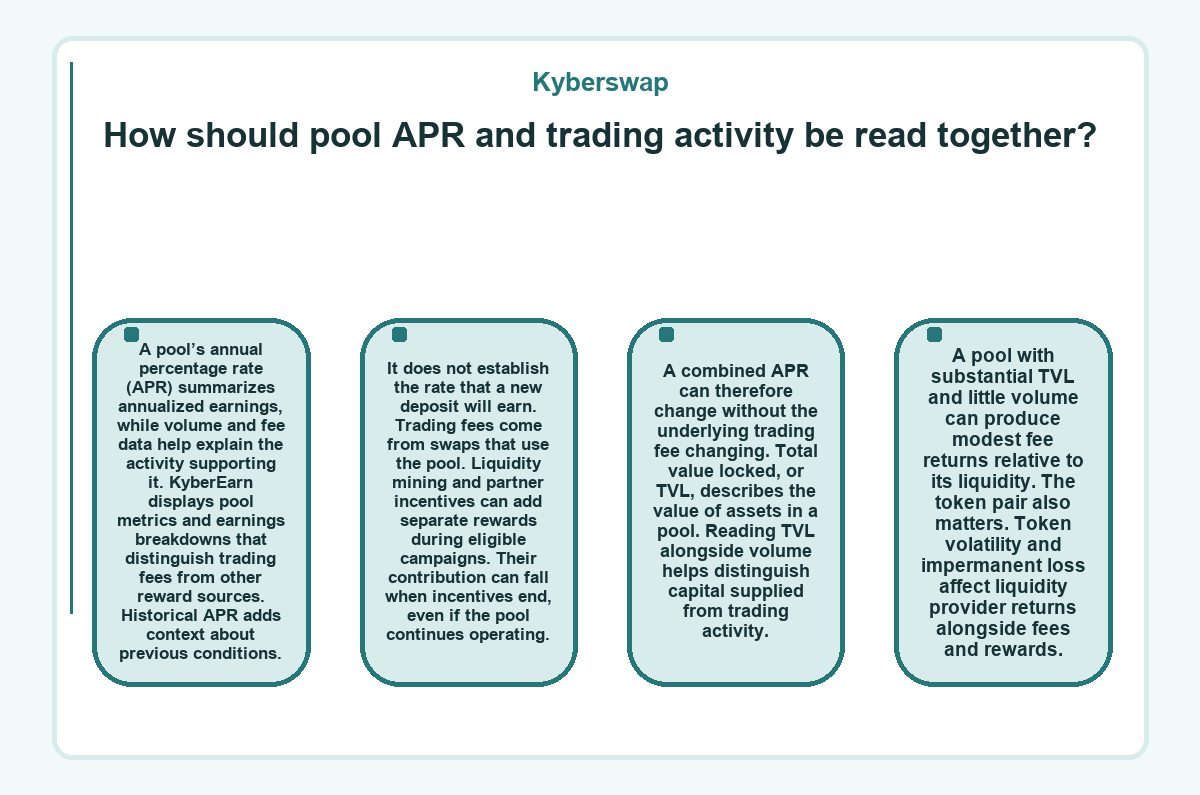
How should pool APR and trading activity be read together?
A pool’s annual percentage rate (APR) summarizes annualized earnings, while volume and fee data help explain the activity supporting it. KyberEarn displays pool metrics and earnings breakdowns that distinguish trading fees from other reward sources. Historical APR adds context about previous conditions. It does not establish the rate that a new deposit will earn.
Trading fees come from swaps that use the pool. Liquidity mining and partner incentives can add separate rewards during eligible campaigns. Their contribution can fall when incentives end, even if the pool continues operating. A combined APR can therefore change without the underlying trading fee changing.
Total value locked, or TVL, describes the value of assets in a pool. Reading TVL alongside volume helps distinguish capital supplied from trading activity. A pool with substantial TVL and little volume can produce modest fee returns relative to its liquidity.
The token pair also matters. Token volatility and impermanent loss affect liquidity provider returns alongside fees and rewards.
How can one token fund a two-token pool?
KyberZap can convert a single supported input token into the assets and proportions required by a two-token pool. An ETH/USDC pool can accept entry funded with ETH alone through a supported Zap. Any necessary conversion follows the selected position’s requirements, including its price range.
| Stage | Component | Deposit action | Deposit constraints |
|---|---|---|---|
| Select the pool | KyberEarn | Choose a supported ETH/USDC pool and its network. | The wallet must use the intended network and hold its native gas currency. |
| Configure the deposit | KyberZap | Choose ETH as the input, enter the deposit amount, and select a price range where required. | KyberZap accepts up to five supported input tokens. |
| Review and authorize | Quote and wallet | Review output, slippage, Zap impact, and fees; approve token spending if necessary. | Spending approval alone does not create a liquidity position. |
| Confirm the deposit | Underlying pool | Confirm the liquidity transaction, then inspect the position in My Positions. | The successful add-liquidity transaction must confirm on-chain. |
| Direct DEX entry | A native protocol interface is an alternative; deposit requirements and management options vary by protocol. | ||
ETH funds this deposit, and the conversion determines the pool assets that enter the position. Choosing one funding token does not fix future income or the position’s later token proportions. Market movement can also change the quoted result before confirmation.
Separate network costs from Zap platform fees
For KyberZap operations that carry a platform fee, the fee applies to the input amount. The token-pair category affects the applicable charge. The interface displays fees before confirmation, alongside the quoted result. Those entry costs differ from the trading fees that an established liquidity position may earn.
Network gas covers blockchain transaction processing. Adding liquidity requires enough native gas currency on the selected chain, in addition to the deposit assets. A wallet may request token-spending approval before the main liquidity transaction. Approval and deposit have different purposes, so review each wallet request in its own context.
Cross-chain quotes can include a platform charge and a separate provider protocol fee, in addition to network gas.
When does the selected price range affect earnings?
Concentrated liquidity earns trading fees only when the market price lies within the position’s selected range. Actual fee income also requires swaps that use that liquidity.
Range width changes the active exposure
A narrow range concentrates liquidity across fewer prices and can improve capital efficiency. It also increases the chance of moving out of range. A wider range covers more prices, with less concentrated capital. Neither width establishes a fixed return, because trading activity and market prices change.
An out-of-range position may remain inactive until the market price returns. Repositioning changes the range where the pool supports that action.
Position management continues after entry
My Positions shows accrued fees, rewards, and range status. Supported management actions include increasing liquidity, claiming fees, withdrawing, compounding, and repositioning. Smart Exit, which the interface labels beta, can automate withdrawal under predefined conditions where available. Zap Out can convert a supported liquidity position into one token when exiting.
These controls leave exposure to token-price movement, impermanent loss, and smart contract risk. Available actions vary by pool and protocol.
Limit orders and cross-chain swaps serve different trading needs
Limit orders target a chosen exchange rate, while cross-chain swaps combine token conversion with movement between supported networks. An order needs an executable match before expiry; reaching a displayed market price alone does not establish a fill. Cross-chain routes depend on provider coverage and liquidity. Their fees and arrival estimates vary by route, so a quote for one route does not establish another route’s cost or timing.
Common questions
Which wallets can connect to Kyberswap?
MetaMask and Rabby are examples of supported wallets for the liquidity workflow. Other supported Web3 wallets can also connect. The connected wallet must use the intended network and authorize the requested transactions. Pool availability and management actions depend on the selected network and protocol.
Does a liquidity deposit always create an NFT?
A liquidity deposit does not always create an NFT. Its representation depends on the underlying protocol, which may use a liquidity provider position or an NFT-style concentrated liquidity position. KyberEarn provides the management interface; the protocol determines the position’s form.
Are FairFlow rewards available in every pool?
FairFlow rewards apply to eligible pools using FairFlow mechanics. Ordinary LP trading fees and FairFlow rewards are different earning sources. A pool can offer trading-fee income without offering FairFlow rewards, liquidity mining, or partner bonuses.
How do Farming and Low Volatility pool categories differ?
Farming categories identify pools that may have active reward programs, while Low Volatility categories generally group stablecoin or correlated-asset pools. A low-volatility pairing can still face token-price changes, smart contract risk, and changing earnings.
Can a Zap input token differ from the pool’s tokens?
A supported Zap input can differ from the target pool’s tokens. KyberZap handles the conversion into the required pool assets when that input and pool are supported. Availability depends on the selected configuration, and the conversion can affect the quoted output and applicable costs.
Do I need ETH on Arbitrum to add liquidity there?
Adding liquidity on Arbitrum requires ETH on Arbitrum for network gas. The token or tokens funding the deposit are a separate requirement. ETH held on another network does not supply the Arbitrum balance needed to pay for that liquidity transaction.